
Structured investment documents and market scenario analysis

Structured Products

Know the Conditions Before You Consider the Outcome.

Explore investment structures through the terms that determine how they behave across different market scenarios.

For investors who want every condition explained
before deciding.

The Core Idea

The Headline Is One Line. The Terms Are the Story.

Every structure needs to be understood on its own terms.

01

Underlying

What does the outcome depend on?

02

Conditions

What must happen along the way?

03

Outcome

What may be paid or returned under those conditions?

Structured investment key terms document showing underlying, conditions and outcome

What We Put Under the Lens

What We Put Under the Lens.

A structured product is more than a payoff. We examine the key elements that shape how it works, so you can assess whether it fits your mandate.

Magnifying glass examining underlying market exposure

Underlying Exposure

What assets, indices or themes determine the outcome?

Investment documents and pen representing structured product payoff rules

Payoff Rules

How do the conditions determine what may be paid or returned?

Documents representing issuer counterparty and contractual agreements

Issuer and Counterparty

Who are the key parties and what are their respective roles?

Hourglass representing investment liquidity and exit timing

Liquidity and Exit

What are the provisions for exit and how might liquidity be affected?

Investment professional reviewing a structured product term sheet

The VIVS Review Lens

Read the Structure in the Order
Risk Appears.

A clear sequence helps you see how the parts fit and where risks may arise.

01

Underlying
Reference

What moves the value?

02

Observation
Dates

When are conditions tested?

03

Triggers and
Barriers

Which events alter the result?

04

Payment Rules

What exactly can be paid?

05

Issuer
Obligations

Who must meet the obligation?

06

Early Exit Terms

How could I leave early?

The Scenario Room

What Happens If the Market Does Something Else?

Different market outcomes can lead to different contractual results. The terms determine what happens.

Positive market scenario representing a condition being met

Condition Met

Review the contractual outcome, including any payments or early exit that may apply under the terms.

Neutral market scenario representing a condition being partly met

Condition Partly Met

Identify the altered payout or continuation terms and how partial conditions affect the result.

Adverse market scenario representing a condition not being met

Condition Not Met

Assess the potential loss and the relevant issuer obligations as defined in the terms.

What You May Gain

These features may make a structured product suitable for some investors.

  • Potential tailored exposure

    Access to specific assets, themes or market views through the terms.

  • Terms known at entry

    Key conditions and potential outcomes are defined up front.

  • A defined investment horizon

    A clear time frame to evaluate alongside your broader portfolio.

Investment adviser and investor reviewing structured product documents

What You May Give Up

These trade offs are important to consider before investing.

  • Complexity

    More moving parts and terms than a straightforward investment.

  • Liquidity flexibility

    It may be harder to exit early, and exit rights depend on the terms.

  • Exposure to issuer and market risk

    Your return depends on the issuer’s obligations and the market conditions described in the terms.

Our Review Ends With

A Plain English Brief.

We summarise the key terms in clear language so you can assess whether the structure fits your mandate, risk tolerance and portfolio.
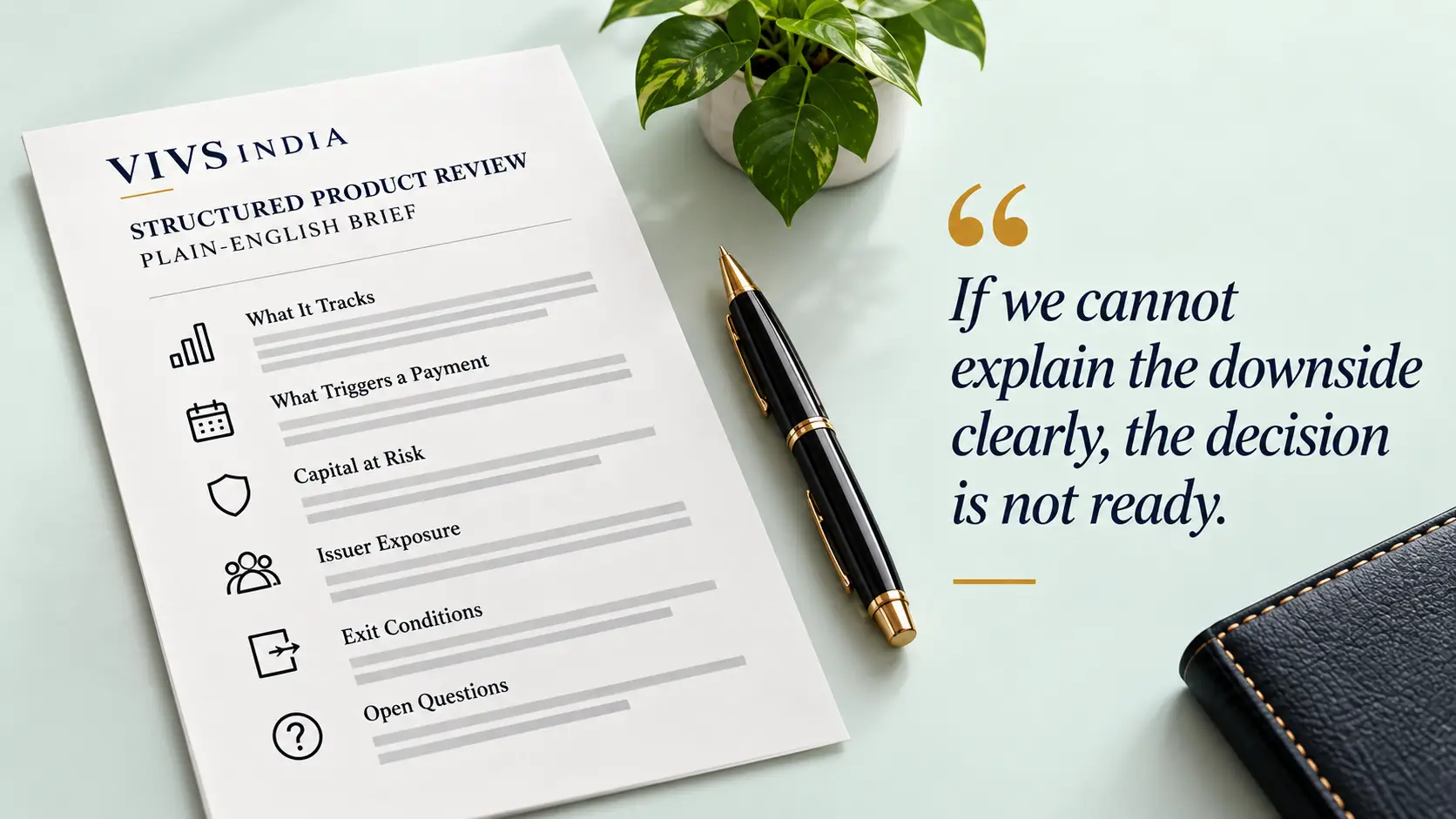
Structured product review brief summarising key terms and downside considerations

The Investor Fit

A Clear Structure Still Has to Fit Your Life.

Worth Exploring When

  • You can explain the conditions in your own words

  • The investment has a defined role in your portfolio

  • The stated horizon suits your liquidity needs

  • You accept the full downside scenario

Pause When

  • You need assured access to your money

  • You expect capital or income to be guaranteed

  • The term sheet leaves material questions unanswered

  • Your exposure to an issuer is already too concentrated

Financial planning desk with a journal representing long-term goals and portfolio strategy
VIVS adviser and investor reviewing investment documents together

The VIVS Journey

From Term Sheet
to Informed Choice.

A clear, thoughtful process to help you understand the structure and decide with confidence.

01

Share
Your Mandate

Tell us your objectives, time frame and key considerations.

02

Review
the Structure

We analyse the terms, conditions and relevant risks.

03

Test
the Scenarios

We assess how different market outcomes may affect the result.

04

Resolve
Open Questions

We discuss any uncertainties and seek clarity where needed.

05

Decide With
Final Documents

You consider the final terms and proceed only if you are comfortable.

Questions Before You Decide

Questions Before You Decide

What determines the outcome?
The outcome is determined by the specific terms of the structure. This can include the underlying reference, observation dates, triggers, barriers, payoff rules, maturity conditions and issuer obligations. We review these elements together so you can understand what needs to happen for each possible outcome.
Can I lose part or all of my capital?
Yes, depending on the exact structure. If capital protection is conditional, a specified barrier is breached, market conditions move adversely, or the issuer cannot meet its obligations, you may lose part or potentially all of the capital at risk. The downside scenario and capital at risk provisions should therefore be understood before proceeding.
What happens if I need to exit early?
Early exit depends on the liquidity and exit provisions stated in the term sheet. An exit before maturity may be subject to prevailing market value, available liquidity, applicable charges or other contractual conditions. The amount received on an early exit may therefore be lower than the original investment amount.
Who is responsible for payments?
The official product documents identify the issuer, provider or other relevant party responsible for making contractual payments. Those payments remain subject to the terms of the product and the responsible party’s ability to meet its obligations. We review these responsibilities so you know who is accountable before capital is committed.
Is a stated outcome guaranteed?
A stated or illustrated outcome should not be treated as guaranteed unless the official product documents expressly provide for it. Actual results depend on the contractual terms, relevant market conditions and the issuer’s ability to meet its obligations. The final documents, not an illustration or headline outcome, define what applies.