
Market Need
Who will occupy, buy or use the asset?
Real Estate Private Equity
Access selected real estate opportunities through a structured, evidence led approach designed around value creation, risk visibility and a considered exit.
For eligible NRIs and overseas investors considering professionally evaluated Indian real estate opportunities.

A Different Starting Point
Who will occupy, buy or use the asset?
Why this price, structure and stage?
What must happen for the thesis to work?
Who could buy next, and under what conditions?
Where the Model Can Apply

Well located residential projects with clear demand fundamentals.

Stabilised or near stabilised assets with sustained occupier demand.

Complex assets where structure, approvals or repositioning can unlock value.

Strategic land assets in infrastructure linked corridors with long term potential.
The VIVS Evaluation Lens
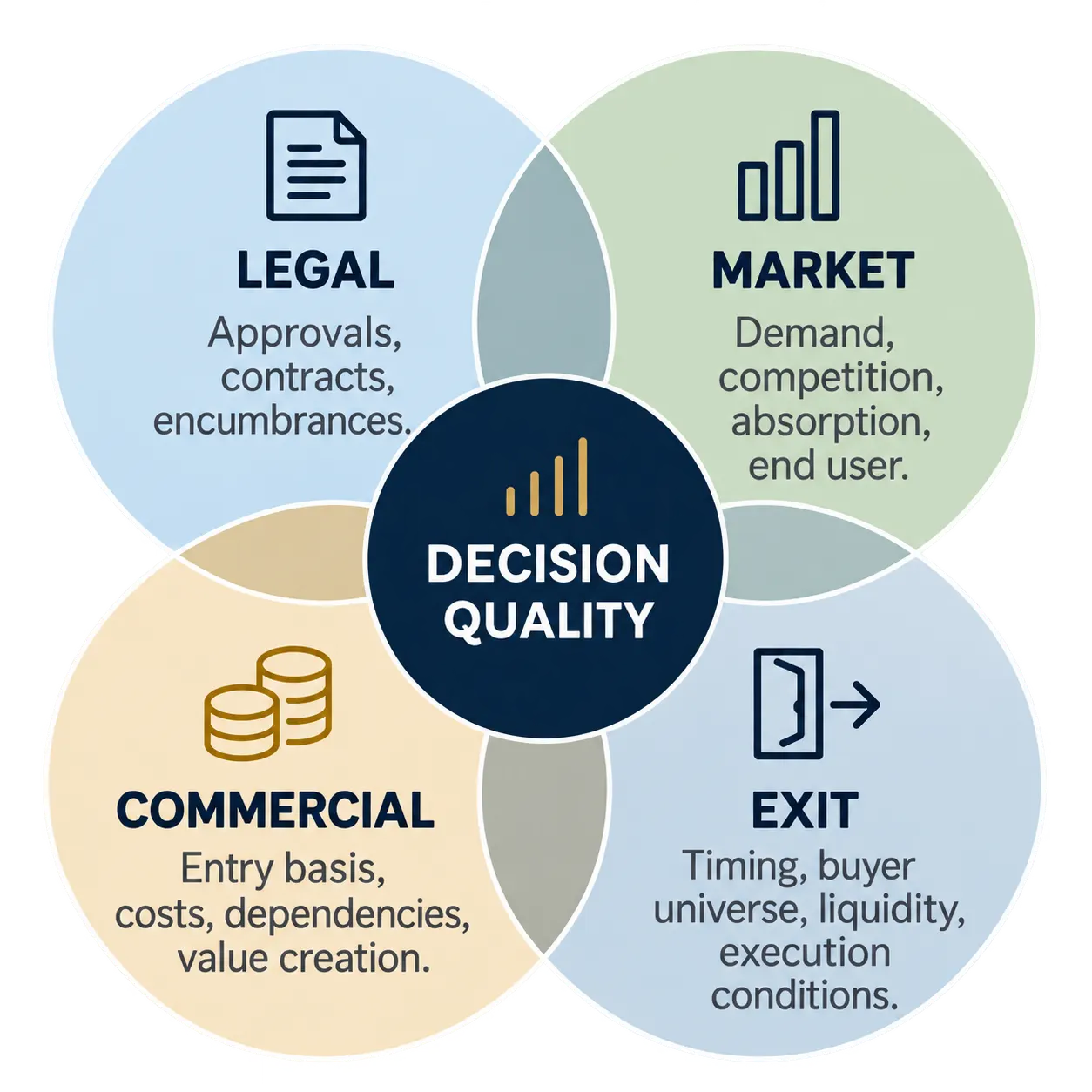
Legal clarity, market demand and financial logic are examined together because weakness in one can change the whole outcome.
What Is Examined
Clarity of ownership, encumbrances and title chain.
Zoning, land use, statutory approvals and compliance path.
Track record, capability, financial strength and alignment.
Entry basis, total costs, value creation potential and key dependencies.
Design, contracts, execution risk and delivery plan.
Market demand, competition, absorption and end user profile.
Rights, information access, approvals and key decision matters.
Timing, buyer universe, liquidity and execution conditions.
The Downside Case
A credible evaluation considers delay, cost pressure, slower sales or leasing, counterparty stress and a later exit.
| Assumption | What Could Change | What We Look For |
|---|---|---|
| Approval timeline | Delay | Time and funding buffer |
| Construction cost | Increase | Contingency and controls |
| Sales or leasing | Slower demand | Pricing flexibility and holding capacity |
| Exit timing | Extended period | Alternative routes and investor readiness |

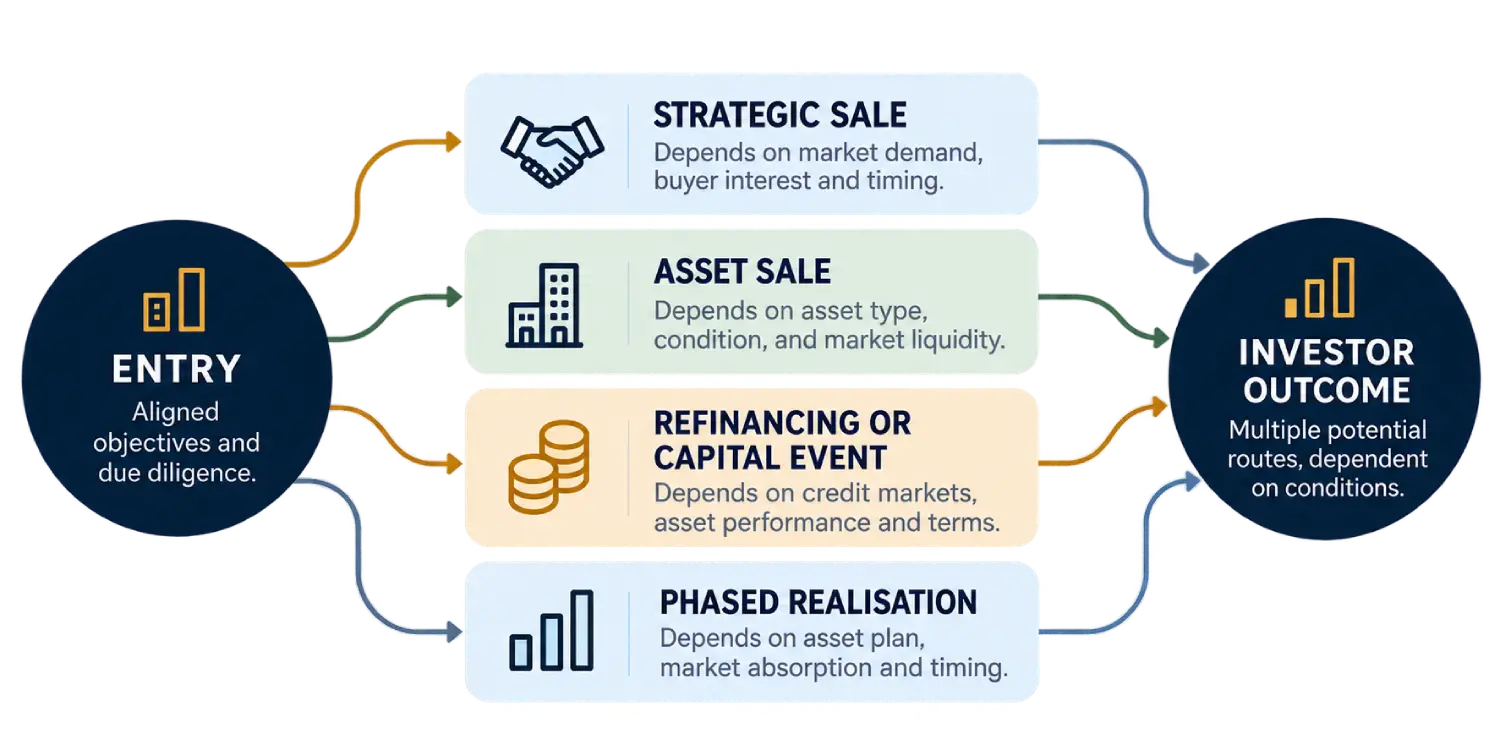
The Exit Starts at Entry
An exit is not a date on a brochure. It depends on readiness, market conditions, buyer interest, documentation and execution.
Is This Approach Relevant to You?
You understand real estate can be illiquid
You can evaluate a medium to long term holding period
You value structured review and reporting
You are comfortable assessing opportunity specific risk
You require assured or immediate liquidity
You expect guaranteed income or appreciation
You cannot tolerate execution or market uncertainty
You prefer decisions based only on headline returns
From Interest to Informed Decision
Your Starting Point
Receive the current verified opportunity list and select the areas relevant to you.
Your information is used only to respond to this request. No public sharing.

No. Direct property ownership and participation in a structured real estate opportunity are different. The investment may involve a defined vehicle, project structure, investor rights and specific commercial terms rather than direct ownership of the property itself.
No. VIVS focuses on opportunity evaluation, due diligence coordination, commercial assessment and decision support. The handling of capital, project execution and related obligations depends on the selected opportunity, vehicle and transaction documents.
Opportunities are reviewed across factors such as ownership and title, land use and approvals, developer or counterparty quality, project economics, demand and pricing, investor rights, execution risk and possible exit dependencies.
Participation may be possible for eligible overseas investors, subject to the specific opportunity, applicable regulations, KYC requirements, banking arrangements, documentation and tax considerations. Eligibility should be confirmed before participation.
The document set depends on the opportunity and stage of evaluation. It may include an opportunity brief, relevant commercial and legal information, transaction documents, disclosures and materials needed to understand the structure, risks, rights and obligations.
No. Real estate private equity involves market, execution, counterparty and liquidity risk. Exit routes and potential outcomes are assessed, but neither can be guaranteed.

Independent opportunity intelligence, legal due diligence and exit planning for NRIs.
India based. Accessible worldwide.
Investment opportunities involve risk. Availability, eligibility and outcomes vary. Review relevant documents before making a decision.